Current Affairs

What happened in the world today? Riots, financial crisis, elections, revolutions... An insight to the World

Business

In-depth analysis and comments about the current worldwide economic situation. Crisis, Recovery, Upraising economies, developing countries, business and finance...

Politics

Political analysis, elections, British political landscape, people's perception on politics, struggles for independence, political battles...

If you are going [...]

Showing posts with label africa. Show all posts

Thursday, 8 September 2011

COMMENT: Metropolis vs. Ex-colonies. Roles reversed?

Source: Daily Mail

PIGS' economic situation is not new. Greece's economy is preparing for its second bailout, after the first one, worth €110bn, failed to boost it. In 2010 its sovereign crisis peaked at a 120% of its GDP (€216bn) and over €20bn were thought to be evaded every year from the Greek tax system. Ireland and Portugal are going through a bailout process, Italy recently announced the biggest spending cuts in decades in an effort to tackle the financial crisis in the country and Spain's economy keeps sinking, with the highest unemployment rate of the whole European Union (almost a 21%), with the collapse of its main industry (building industry) and with financial problems that forced small banks to merge in big entities capable of resisting the crisis.

What is rather new, however, is the situation of some of their former colonies. European powers created a vast network of supplying colonies all around the world, that they exploited for centuries. After lengthy struggles (most of them violent), almost all of these colonies became sovereign states, but in most cases what remained after European colonialism were lawless territories with rivalries that led to bloody civil wars, unexisting economies, and a massive dependence from the ex Metropolis.

Now, tables have turned in some cases. In 2011 Portugal and Spain have become some of the most badly hit economies of the whole European Union. But some of its ex colonies, such as Angola, Paraguay or Brazil are experiencing an economic boom despite the financial crisis.

Public debt in 2010 (% of the GDP)

The difficult situation in Portugal has forced many Portuguese to leave their country, some of them transferring to the ex colonies, trying to find a new life. Exactly the same that people from the ex colonies did until recently, but all the way round.

According to The Economist, in 2007-08 there were 45,000 Portuguese registered in Angola. Only one year later, they were 92,000. Also Angolan banks have started buying stakes in Portuguese banks, as Banco BIC has just done with Banco Português de Negócios. The IMF has forecasted a growth of a 7.8% of Angolan GDP in 2011 and a 10.5% in 2012.

The same can be applied to Brazil, where its two economic giant hubs, Sao Paulo and Rio de Janeiro, fight to be considered the most appealing centre where to invest in the country.

Rio has been designed to host the 2016 Olympics, which will bring millions in cash and investments to Brazil's Treasury. Also, in 2010 foreign direct investment peaked at $7.27bn in Rio and $2.73bn in Sao Paulo. The cost of living in both cities has increased in the last year. In 2011 Rio was the 12th most expensive city where to live in the world (it had been the 29th in 2010). Sao Paulo fared even better, entering the top 10 most expensive cities in the world this year (from the 21st position in 2010).

Spain, formerly regarded as one of the most powerful economies of the world (its GDP grew an average of a 3.5% before the crisis and it was the fourth biggest economy of the European Union), is now surpassed by some of its former colonies. According to the CIA World Factbook, in 2009 Spain entered recession, growing a -3.7%. Last year its GDP still grew a -0.1%. On the other hand, in 2010 Paraguay's GDP grew a 15.3%, Argentina's a 9.2%, Peru's an 8.8% and Uruguay an 8.5%.

On the other hand, it is said that the financial crisis is a worldwide crisis affecting every country, but figures show that the hardest-hit economies are those of the so-called developed countries, such as in Western Europe, US, Canada and Japan. South America, Southern Africa, China and even Eastern Europe are doing relatively well (see map above).

Seeing these figures it is easy to understand why foreign investment is shifting to new markets, and why migration trends might have changed.

By CDR with No comments

Sunday, 21 August 2011

NEW PROJECT: The World in Black and White (365 days of B/W)


The World in Black and White (365 days of b/w) is a project launched in August 18 by Carlos del Romero/Worldindepth. It aims to present 365 photographs in black and white, one for each day of the year, from different places around the world, taken in the last ten years. The photographs are then presented as visual poetry, embedded with brief comments that tell the story behind the picture.

In the next 365 days we will see pictures from places in Spain, England, Scotland, Wales, Canada, the U.S., Bulgaria, Serbia, Bosnia, Croatia, Czech Republic, Italy, Jordan, Morocco, France, Turkey, Hungary...

Although every photograph will show a feature of a different country, these won't be arranged in a geographical order. The focus of the visual story will be one element in the photograph, regardless of the location.

By CDR with No comments

Thursday, 12 May 2011

FEATURE: Beyond the Libyan spring

Rebels on top of a captured tank. Source: AP

On March 2004, Tony Blair, then the British Prime Minister, visited Libya and received a warm welcome from Colonel Muammar Gaddafi. It was the first British politician to visit the country on a diplomatic trip after UN and US sanctions were lifted in 1999 and 2006 respectively. Blair then praised the booming economy of the country and the government's commitment in the fight against Al-Qaeda. As he put it, "I have been struck by how Colonel Gaddafi wants to make common cause with us against extremists and terrorism. The signs are better than they have been for many years. And the future prize in terms of security not just of this region but the wider world, indeed our own country, is great".

Exactly seven years later, on March 2011, UN's Security Council approved resolution 1973, imposing a no-fly zone over the country and authorising "all necessary measures" to protect the civilians against the Libyan army, boosting the rebels' aspirations. Only a few days before, France had become the first country to recognise the rebels as the legitimate government of Libya. But who are the rebels?

First time the world heard about the Libyan rebels was last February, after demonstrations held in the main cities of the country against Gaddafi's tough regime were firmly repressed by the use of military force. A few weeks later, the demonstrators organised themselves and occupied Benghazi, Libya's second biggest city, making it their stronghold. Further combats drew Gaddafi's forces back, while the rebels advanced towards the capital Tripoli.

According to Imad El-Anis, Libya specialist and lecturer in International Relations at Nottingham Trent University, "the ‘rebels’ are a diverse range of people: some are soldiers who in effect defected, some are people who are still closely linked to one tribe or another, but basically they are a patchwork of ordinary Libyans from all walks of life who have the same cause: reform of their government. The military response that the regime took against the pro-reform movement in its early stage also pushed ordinary civilians into the ‘rebellion’ in order to defend themselves."

On the other hand John Pike, director of defense think tank Globalsecurity.org points out that the conflict between the rebels and the Libyan government is the result of clashes between different tribes in the country. He argues that when Libya was created it forced different existing ethnias and tribes to form part of the same political territory, sharing an artificial governance in an artificial country.

"Libya is a divided country, and one underlying dynamic in play here is the conflict between Cyrenaica and Tripolitania. Although both territories had been united into Libya at independence in 1951, for the previous three thousand years these two territories had persisted as separate and distinct entities. Decades of Libya had not overcome the differences of millennia, and a territorially based civil war was the natural product of these distinctions. In Cyrenaica, the tribe was the chief focus of social identification. In Tripolitania, by contrast, loyalty that in a social context was reserved largely to the family and kinship group could be transferred more easily to a political party and its leader. The separateness of the regions is much more than simply geographical and political, for they have evolved largely as different socioeconomic entities, each with a culture, social structure, and values different from the others. Cyrenaica became Arabized at a somewhat earlier date than Tripolitania, and beduin tribes dominated it", explains Pike.

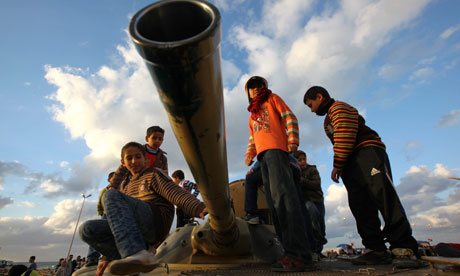
Children play on a tank in Benghazi. Source: EPA

Libya's rebels have become an armed group that fights a guerrilla-like warfare against government forces in the country. The emergence of this insurgent group is linked with the events that took place in Egypt and Tunisia early this year.

Tunisia and Egypt undertook a relatively peaceful revolution, removing the historical leaders of both countries from power, Ben Ali in Tunisia and Hosni Mubarak in Egypt. They had ruled their countries firmly for decades, but massive pacific protests and social pressure made the two leaders step down from power, putting an end to these tough regimes without a shot being fired.

Libya's situation, however, was different. Here Gaddafi reacted with violence to the first protests, ordering the army to open fire to the demonstrators. Whereas in Tunisia and Egypt the army decided not to intervene, in Libya it was tightly controlled by Gaddafi. The violence by which government forces reacted to the protests led to a military uprising in the East of the country, carried out by a force later known simply as "the rebels".

According to Dr. Eugene Rogan, Director of the Middle East Centre at Oxford University, "the uprising has led to civil war in Libya because the army has split, so there were armed elements in Benghazi siding with the opposition, and loyalist military units in Tripoli to support Gaddafi. It could be simply that those furthest from the capital were able to rise up against the regime with less risk than those closest to Tripoli".

Dr. El-Anis, on the other hand, argues that the difference between Libya, on one hand, and Egypt and Tunisia, on the other, underlies in the social and military structure of these countries.

"The military response that we saw in the early stages of the movement in Libya is the key difference. In Tunisia and Egypt the military was not used against the civilian movement. In both cases the military refused and instead basically sided with the masses. The military structure in Libya is quite different and is very closely controlled and connected to the regime and the ruling family in particular. Furthermore, the military response that the Gaddafi regime insisted on in the early stages was quite disproportionate and did not leave room for any kind of negotiated process of reform like we have seen in Morocco, Jordan and Oman", explains El-Anis.

The rebels, an heterogeneous group of armed militia, soldiers and civilians, didn't seek for Western military support from the very first moment. In the first weeks they carried out a blitzkrieg-style offensive that took them almost as far as 20km away from the capital, Tripoli. But a counter-offensive by the government forces, through their 22,000-man strong air force, pushed the rebels back to Benghazi. The rebels' strategy changed then, seeking for support from Western countries.

The Libyan conflict and the pipelines. Source: Stratsis Incite

On March 18, only 24 hours after Resolution 1973 was approved by UN's Security Council, French planes bombed, for the first time, positions held by Gaddafi. It was seen as a victory for the rebels, which conceived the Western intervention and the setting up of a no-fly zone as a definitive boost to their interests. But the Western support proved insufficient as Gaddafi forces resisted the strikes and advanced farther towards the rebels' stronghold of Benghazi.

The Western intervention also aroused ignited discussions among the allied countries. The initial discourse was based on the premises of protecting the civilians through a series of air strikes that would hit Gaddafi's military forces. The irruption of land forces was rejected since the very beginning. Only now, after months of a stalemate in the battle and the continuous claims of the rebels for Western support, UK, France and Italy discuss the possibility of sending "advisors" to the rebels .

"I do not think the Western powers will commit land forces to Libya. They seem to regret getting so deeply involved already, and the recent strike on the Gaddafi family residence suggests they are trying to hasten an end by killing Gaddafi himself. While the Afghan war continues, neither the US nor the UK will be willing to enter any new Afghanistans", says Dr. Rogan.

Dr. El-Anis also points out that the situation has reached a critical point. "We can be sure that on the ground and behind closed doors in decision making circles there is still a lot of activity. I think NATO forces understand that the situation will not be eased for quite a few weeks and months. There is very little chance of NATO or any other soldiers on the ground in Libya any time soon", explains.

The situation has reached a point in which none of the combating forces seems a clear winner. According to a research carried out by IHS Global Insight, an American think tank, "NATO allies will be stuck between a rock and a hard place for the foreseeable future, fearing being dragged into a prolonged conflict for which they might be forced to take responsibility. The more active allies, UK, France and US might therefore seek fresh means of engagement, through non-lethal military aid, such as the package declared by the US on 20 April, and logistical and training support. However, without a strategic military shift that swings the power balance decisively in the hands of the rebels, the stalemate is set to drag on ".

The UN has also warned that more funds would be needed to support "relief operations" in Libya. "Unless funds are swiftly committed by donor countries, this shortfall will likely impact vital humanitarian assistance for tens of thousands of people displaced by the recent fighting", said UNHCR spokesperson Andrej Mahecic .

The shortage of Western military and economic support would be a hard blow to the rebels' aspirations.


A Libyan rebel guards a checkpoint in Brega. Source: Stratsis Incite

The current situation seems far from being resolved. Experts have already warned that the conflict in Libya could evolve into a permanent civil war with the presence of NATO forces, transforming the country into a new Afghanistan. Former Libyan Foreign Ministry, Moussa Koussa, which fled the country in early April, told the BBC that "taking Libya into civil war would lead to so much blood and Libya would be a new Somalia".

A rebel victory in the conflict seems unrealistic right now, and it will certainly never happen without Western support. In that unlikely situation, Libya could end up being ruled by an unknown leader under the close surveillance of the UN and the Western powers. This would appease all the factions involved in the conflict, as happened in Afghanistan with Mohammed Karzai. Western leaders have asked Gaddafi to step down from power and go into exile in several occasions. Still, even if the rebels win with Western support, there is a high risk of confrontation between different factions, given their heterogeneous nature.

"The future in Libya no doubt will involve regime change. The US, UK and France have all pledged not to stop until Gaddafi goes, so they have made that much clear. In the absence of sound state institutions, the scope for collapse and further conflict is a present danger. A UN trusteeship cannot be ruled out to help the Libyans secure their country post-Gaddafi while shaping new institutions of government", says Dr. Rogan.

Middle East experts at Quilliam, a counter-extremism think tank, argue that the Western powers should indeed back the creation of a national anti-Gaddafi coalition. "Such a broad national coalition could become the basis for a transitional government that could guide Libya towards achieving a just, representative and democratic government. The creation of a broad-based, respected and widely-accepted transition government with a large military component will be necessary to create a suitable environment in which Libya’s first free and fair post-Gaddafi elections could be organised", explain.

Dr. El-Anis, on the other hand, warns that the conflict will be long, and the possible future scenarios are not very clear. "The rebels don’t have much chance of success if international pressure on Gaddafi eases off. Financially speaking the regime is running out of funds and this is probably going to be the key. Ultimately though I don’t think the rebels are likely to be able to overthrow the regime militarily and likewise Gaddafi’s forces are not likely to be able to militarily re-assert their control over much of Libya as long as NATO is involved. Eventually I think we will see some kind of progressive political process alongside the military one and the removal of the Gaddafi regime is still what I think will happen", argues.

Saif Al-Islam, heir to Gaddafi's regime. Source: AFP

Another situation could see Gaddafi fleeing the country and his second son, Saif Al-Islam, ruling it but undertaking several reforms which will try to appease the Western powers. Mr. Al-Islam, who studied at the London School of Economics and owned a mansion in London, still enjoys a close relation with prominent figures in the UK. He also told in an interview published in The Spectator, back in 2002, that once in power his policy would be focused on transforming Libya into a Western-like democracy .

Whatever happens, the prospects of a rapid and clear victory of the rebels seem highly unlikely.

By CDR with No comments

Thursday, 17 March 2011

FEATURE: Muhammad's unrest

King Muhammad VI

As Saudi Arabia intervenes in Bahrain and Col. Gaddafi fights back the rebels in Libya, the rest of the Arab world tracks expectantly the evolution of the uprisings in the troubled countries, fearing contagion to their own lands.

The first protests in Tunisia and Egypt and, above all, the positive result they achieved, shook the political roots of the rest of the countries in the Arab strip in north Africa and in the Middle East. Within weeks, almost all the Arab countries registered major protests in the main cities, where citizens demanded, at the very least, political reforms.

The unrest spread even to Morocco, one of the most stable countries in the region, and a Westernised nation ruled by king Muhammad VI. The protests have achieved their goals in Egypt and Tunisia, overthrowing the dictators that firmly ruled the countries for decades, and have led to an almost open civil war in Libya. But, will ever Morocco fall into such turmoil?

Contrary to what is commonly thought, currently Morocco is one of the countries with less GDP of the region, with a GDP per capita much lower than Egypt's and roughly half that of Tunisia, for instance. Yet experts say that it is highly unlikely that Moroccans will ever try to remove king Muhammad VI from power.


Source: CIA factbook

Amid the turmoil

The wave of protests which shook all the Arab world arrived to Morocco on February 20th, when over 5,000 demonstrators gathered at Bab al-Had square in Rabat, calling for change. According to Human Rights Watch, hundreds of people demonstrated also in the main cities such as Casablanca, Agadir and Marrakesh.

The protesters set fire to police stations in Marrakesh and Larache, and vandalised a stadium, two political offices and two hotels in Hoceima, according to the Moroccan Association for Human Rights. During the unrest five people died at a bank that was set on fire.

Just one day after the demonstrations took place all over the country, king Muhammad VI announced the creation of the Social and Economic Council, which would have the task of monitorising and carrying out reforms. It was a first movement towards the citizenship. Muhammad also added that the main priority for the executive would be fighting against poverty.

The last Wikileaks cables revealed that the royal Alaouite family was corrupted, and had been wasting thousands of dollars in the last years. On the other hand, the official unemployment rate of the country is only at 10%, but several Moroccans don't have any job, raising the doubt of the actual accuracy of these figures.


Source: BBC

Morocco's future scenarios

The removal of Ben Ali and Mubarak and the clashes registered in Libya and Bahrain lead to a question difficult to answer: will these 'Jasmine revolutions' spread all over the Arab countries, deposing all the long-term monarchs and dictators that have ruled these nations for decades?

Albeit the question remains complicated, experts agree that it is unlikely to see a change in the Moroccan regime. According to Jillian C.York, a freelance journalist based in Morocco, the public opinion is strongly divided between support for the monarchy and a move toward a parliamentary democracy. Yet the king has only been in power for 12 years -unlike in Libya, Egypt and Tunisia-, and hence the Moroccans don't have the same sense of frustration. On the other hand the demands of the protesters were mainly directed to a move to a parliamentary democracy where the king will play a minor role -like the Spanish one-, an end to corruption and more economic balance.

Journalist Matt Schuman explains that the situation in Morocco is very different from that of Egypt, Libya and Tunisia. Despite having a lower GDP, the poverty is not oppressive, and the Moroccans can live a simple life without being rich but neither without starving.

Another difference, according to Schuman, is that whereas in Egypt and Tunisia the protests were driven by a cultural elite of educated youngsters and intellectuals, Morocco suffers from a lack of literacy. Only around 50% of the population is educated, and therefore "Moroccans' illiteracy hampers the spread of information in general, and would definitely impede the organization of any type of protest movement".

Finally, Moroccans don't want to depose the king. Although there is a Prime Minister, political parties and elections, the lesser political bodies are corrupted. However, the royal family is seen as a 'credible figure'. On the other hand, since he was crowned king of Morocco, 12 years ago, Muhammad VI has carried out some political and social reforms, allowing certain freedom and democracy in the country.

According to Jillian C.York, "Moroccans who support the protests are generally taking advantage of the current political climate on the region, but they are not seeking the same things; they are not hoping to overthrow the king. The king is well-liked and has not been in power for very long. He has made major changes during his 12 years of rule and much of the country is happy with that".


The revolutions' third way?

Last week, and after nearly a month watching in silence the evolution of the uprisings in the neighbouring countries, king Muhammad VI announced in his first national address since the uprisings "comprehensive constitutional reforms", where "individual and collective liberties will be expanded". He also promised that the power to name the Prime Minister will be transferred to the Parliament. Moreover, he added that some powers will be devolved to Morocco's regions and the figure of Prime Minister will have more powers. The proposals for the reforms will be carried out by a special committee created ad-hoc, and will be submitted in June. It might be the beginning of a more democratic Morocco, meeting some of the demands of the protesters and becoming the Jasmine revolution's third way, aside from the overthrowing of the ruling class in Egypt and Tunisia, and the open war in Libya.

By CDR with 1 comment

Saturday, 12 March 2011

COMMENT: The Libyan jigsaw


As Gaddafi fights to recover the eastern enclaves ruled by the protesters, uprisings have been registered in the western cities, where oil workers are planning to go on a massive strike that will threaten to paralyse the economy of the country.

In the last days the Libyan government has ceded some enclaves in both the eastern and the western regions of the country to the protesters who demand democratic reforms and the end of the dictatorship of Muammar Gaddafi, in power since 1969. Reports say that the ruling Libyan government has ordered to open fire against the protesters in the capital Tripoli, and organizations such as Human Rights Watch claim that there are more than 300 killed.

Protests in the main cities of the country have been repressed with brutality by the regime. Gaddafi has warned that he won't flee the country, and has threatened to start an open civil war if protests don't end immediately. In the meantime thousands of foreigners have fled the country as the protests increase.

Despite the turbulent situation of the country, Col Gaddafi's son, Said al-islam Gaddafi stated that the everything was "normal" in the main cities, where "ports, schools and airports are all open", he said.

font: CIA factbook

The current unrest in Libya has been a matter of discussion everywhere in the last days. John Griffiths, from the Socialist Worker Party in Wales, said that these uprisings in the Arab World have common features: "All of these countries have repressive regimes, but for decades they could offer bread to the population. Now they can't anymore. There is great luxury and wealth next to poverty, huge numbers of graduates leaving universities and a high unemployment rate. These are increasingly unpopular regimes with high levels of repression", stated.

Libya has many bonds with European countries. Gaddafi has an excellent relation with Italian Premier Silvio Berlusconi, and other European economies maintained a good relation with the Libyan regime until the first clashes took place. United Kingdom also had trade agreements with Gaddafi, according to Griffiths: "Three months ago we were selling weapons to colonel Gaddafi to repress his people", said.

Currently Wales has tight bonds with Libya. There is a Libya-Wales Exchange association, which seeks to tighten collaboration between both countries in different areas such as culture, business and education. On the other hand, Cardiff University hosts a Libyan students society, and Cardiffians find the situation in Libya very worrying.

"The situation there is very bad. The problem is that these countries have been ruled by dictators and now they have to fight to get freedom", said Alen Gordon, from Cardiff.

The arab minorities in Cardiff also have their voice about the matter. Raed Baconi, from Lebanon, argued that "it is time for people to speak. The government has to work for the people, not for them, and now we are seeing that people are fighting to have the chance to speak". Ahmed Boulaz, an Algerian emigré, expressed his hope for a democratic future in the region: "What is happening in the arab countries reminds me of what happened in eastern Europe twenty years ago. The problem is that this dictators might be replaced by other dictators, that's why this is a very delicate moment for these countries. People have to make sure that they get a real democracy now", stated.

The unrest in Libya, one of the main oil exporters in the world, has also had a major impact in the price of crude oil. It has hit the $110 per barrel for the first time in the last three years, and it is likely that the prices will rise even further in the next days.

font: article.wn.com

Oil prices

As the situation worsens in the positions held by the rebels, a fear of an open civil war has hit the whole country. The situation seemed to be controlled by the rebel forces, who were firmly advancing to the capital Tripoli from their main base in Benghazi, in the east of the country. However in the last days a counter-offensive carried out by forces loyal to Col.Gaddafi has undermined the tenacity of the rebels.

An offensive with tanks and air raids have hit the rebels, stopping their march towards the capital. The main fear now is that the conflict will be stuck for months and the situation will worsen.

The latest armed struggles in Libya also have had a direct impact on the price of the oil, rising almost $7 since last Monday and reaching $115 per barrel, the highest price since September 2008, where the price rose triggered by the economic crisis.

The clashes between the rebel forces and the Libyan army have hit the oil terminal at Ras Lanuf, damaging the factory. Experts fear now that the price of the oil will reach another historical maximum, as Col.Gaddafi prepares to bomb oil factories in the rebel territories in order to undermine the economic income they generate and retake the control of the region.

The main consequence is the instability of the stock markets around the world. Investors fear that the uprisings in Tunisia, Egypt and, above all Libya will spread to other oil-producing Arab countries, stopping the oil exports and therefore hitting the world markets.

Experts warn that an open civil war in Libya would hit very badly the world's economy by stopping the oil exports and therefore rising the crude oil prices.

In order to avoid nervousness among the investors, the US Government has admitted that is considering tapping its oil reserves to give more confidence to the stock markets and to try to stop the rising of the oil crude prices.

On the other hand both Britain and France are pushing to win support at the United Nations with the objective of setting a no-fly zone which won't allow Col.Gaddafi's forces to bomb the oil facilities in the eastern territories held by the rebels.

Libya is currently one of the main oil-producing countries, holding around 2% of the world's oil reserves. The production of crude oil has fallen since the start of the riots. Before the uprisings Libya produced 1.6 million barrels per day, and after almost one month of unrest the output has fallen to 1 million barrels per day.

By CDR with No comments

Thursday, 19 August 2010


By CDR with No comments
Powered by Blogger.

Followers